WORLD · THE CROW
SPAIN'S NIGHTMARE: 69 DEAD AFTER A CHAIN OF FAILURES LEFT TWO HIGH-SPEED TRAINS ON A COLLISION COURSE
THE 17 MINUTES THAT CHANGED EVERYTHING A signalling-system failure. Two high-speed trains. A series of warnings and decisions that investigators are now examining. On October 28, 2026, a Renfe train collided with a stationary Iryo train near Urda, Spain. By October 29, 69 people had died. The central question is why the moving train was authorized to continue at normal speed despite the signalling problems and warnings from the other train. The investigation is ongoing. Spain is mourning, and families are demanding answers. How could this happen?
 Posted by The Crow Newsroom
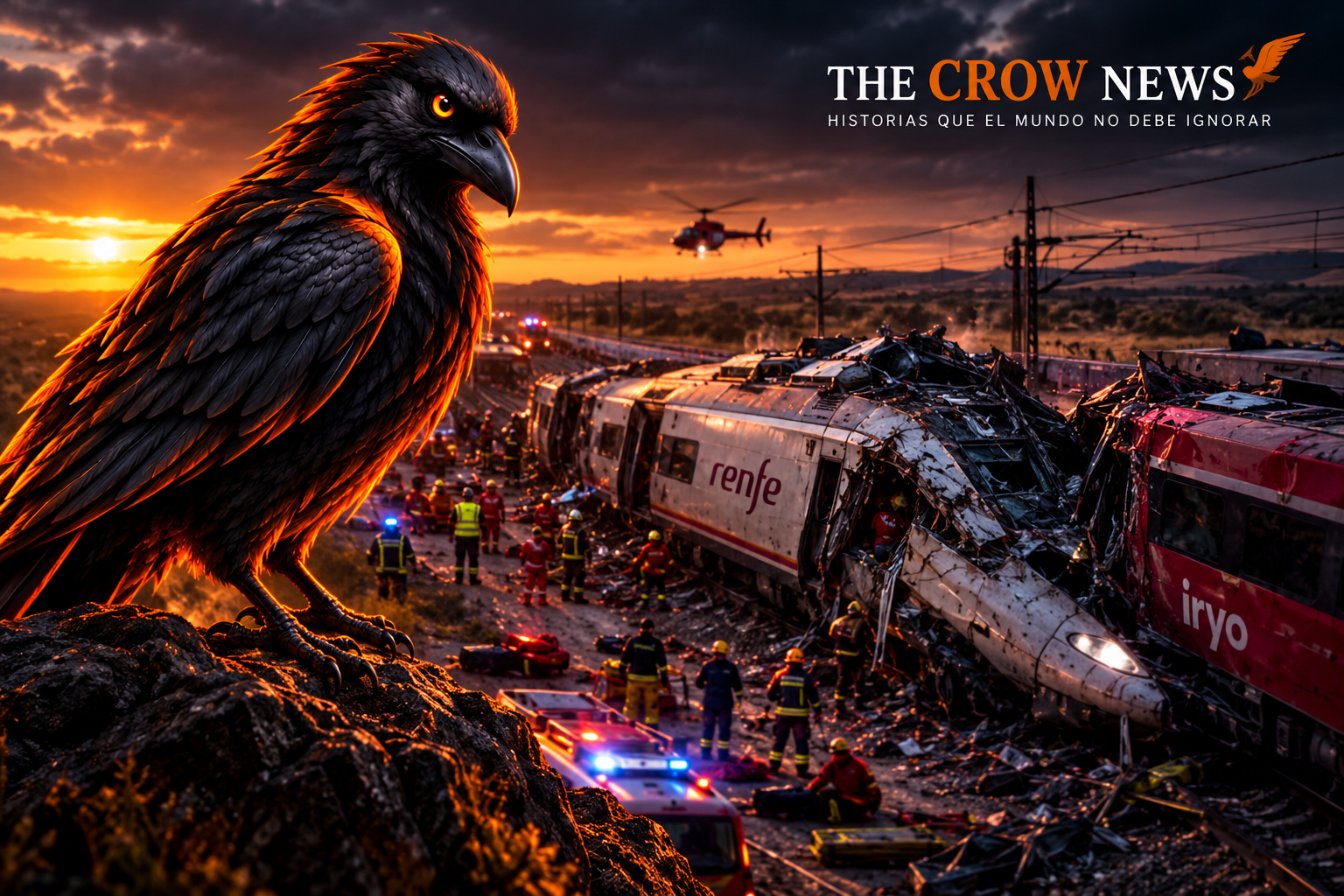
THE CROW NEWS | OCTOBER 29, 2026
Seventeen minutes. Two trains. A failed safety system. And a series of decisions that investigators are now desperately trying to understand.
A journey that became a catastrophe
Spain is mourning one of its worst railway disasters in more than a decade.
On Wednesday morning, October 28, two high-speed trains collided near Urda, in the province of Toledo. A Renfe train struck the rear of a stationary Iryo train on the Madrid–Seville railway line.
By Thursday, October 29, the death toll had reached 69. Dozens of people remained hospitalized, and rescue workers continued recovering victims from the twisted remains of the carriages.
The collision was so violent that several carriages derailed, with some plunging down an embankment.
Families are waiting for answers. Survivors are trying to understand how an ordinary journey could turn into such a tragedy.
But perhaps the most disturbing part of this disaster is what happened immediately before the collision.
The 17 minutes that investigators must explain
According to preliminary information and communications reported by Spanish media, the sequence of events began around 8:30 in the morning.
08:30 — The safety system fails.
A technical failure affects the LZB railway signalling system, which helps monitor train movements and maintain safe distances. Several trains along the affected section are forced to stop.
08:36 — Permission to continue.
An Adif control-centre operator authorizes the Renfe train to resume its journey under normal running conditions.
08:41 — A warning from the other train.
The driver of the Iryo train reports difficulties and remains stopped near Urda.
08:48 — Another warning.
The Iryo driver communicates again that the train is still unable to move.
08:53 — Disaster.
The moving Renfe train collides with the stationary Iryo train.
Five minutes after the second warning, the collision occurs.
These communications have become central to the investigation. Investigators must establish exactly what information was available to the control centre, which instructions were issued and why the collision-prevention safeguards did not work.
How fast was the train travelling?
The preliminary technical report estimates that the Renfe train was travelling between 160 and 220 kilometres per hour when it struck the stationary train.
The precise speed has not yet been established through the train's recorded data.
The investigation is examining whether alternative safety procedures were correctly followed after the original signalling system failed.
One particularly important question is why the Renfe train was reportedly authorized to continue at normal speed rather than under restricted, visibility-based operating conditions.
This was not an isolated railway tragedy
The disaster has another disturbing dimension.
Spain had already suffered another deadly high-speed railway accident in January 2026, when 46 people died in a collision near Adamuz, Córdoba.
The two accidents have intensified public scrutiny of railway safety, maintenance and infrastructure management.
Spain operates one of Europe's largest high-speed rail networks. Its railway system is an important symbol of national infrastructure and technological achievement.
Now, passengers and families are asking difficult questions about the systems designed to protect them.
The people behind the numbers
Behind every number is a person.
A parent who was expected home that evening.
A child who was travelling with family.
A worker returning from a journey.
Someone who bought a ticket believing that the railway systems around them would keep them safe.
The families of those who died are now facing a reality that no official statement can adequately explain.
Three days of national mourning have been declared in Spain.
The questions that remain unanswered
The investigation is still in its early stages. No final determination of responsibility has been made.
Authorities and technical investigators must establish:
- Why did the LZB safety system fail? - Why was the Renfe train authorized to resume normal-speed operation? - Why did the warnings from the Iryo driver not prevent the collision? - Why did the alternative safety procedures fail to prevent two trains from occupying the same section of track? - Were there earlier warnings about the railway infrastructure or working conditions that should have been addressed?
The answers matter not only to Spain, but to every country whose citizens depend on complex transport systems every day.
THE CROW'S FINAL QUESTION
We build faster trains, smarter machines and increasingly sophisticated transport networks.
We trust computers, signals, control centres and the people responsible for keeping us safe.
But what happens when several things go wrong at the same time?
And when a warning is received, who makes sure that someone actually listens?
69 lives have been lost. The investigation must now establish how a chain of failures became a catastrophe.
The world deserves answers.
---
SOURCES & FURTHER READING
- Reuters — Spain's death toll rises to 69: https://www.reuters.com/world/europe/spanish-rescuers-search-trains-hope-finding-survivors-deadly-crash-2026-10-29/ - Euronews — The 17 minutes before the collision: https://www.euronews.com/2026/10/29/spain-train-crash-what-happened-in-the-17-minutes-before-the-collision - Associated Press — Initial reporting on the disaster: https://apnews.com/ - La Sexta — Preliminary technical investigation: https://www.lasexta.com/noticias/sociedad/informe-preliminar-tragedia-urda-69-muertos-colision-mas-160-kmh-raiz-cadena-averias-instrucciones-acciones_202610296ae3cd4c02501232156d48cb.html
---
ENGLISH EDITION
SPAIN'S NIGHTMARE: 69 DEAD AFTER A CHAIN OF FAILURES LEFT TWO HIGH-SPEED TRAINS ON A COLLISION COURSE
THE CROW NEWS | OCTOBER 29, 2026
Seventeen minutes. Two trains. A failed safety system. And a series of decisions investigators are now desperately trying to understand.
A journey that became a catastrophe
Spain is mourning one of its worst railway disasters in more than a decade.
On Wednesday morning, October 28, two high-speed trains collided near Urda, in the province of Toledo. A Renfe train struck the rear of a stationary Iryo train on the Madrid–Seville railway line.
By Thursday, October 29, the death toll had reached 69. Dozens remained hospitalized as rescue teams continued searching through the wreckage.
The collision derailed several carriages, some of which plunged down an embankment.
But the most disturbing part of this disaster may be what happened during the seventeen minutes before impact.
Seventeen minutes before disaster
At approximately 8:30 a.m., a technical failure affected the LZB railway signalling system, forcing several trains to stop.
At 8:36, an Adif controller authorized the Renfe train to resume normal-speed operation.
At 8:41, the Iryo driver reported that her train remained stopped near Urda.
At 8:48, she communicated again that the train was still unable to move.
At 8:53, the Renfe train collided with the stationary Iryo train.
These communications are now central to the investigation.
A disaster that raises bigger questions
Preliminary technical findings estimate that the Renfe train was travelling between 160 and 220 kilometres per hour at impact.
Investigators are examining why the alternative safety procedures failed after the signalling system malfunctioned.
The exact speed and sequence of events still need to be established using recorded train data.
Spain has suffered another deadly railway disaster
In January 2026, another high-speed train accident near Adamuz, Córdoba, killed 46 people.
The two tragedies have renewed questions about railway infrastructure, maintenance and operational safety.
The people behind the numbers
Behind every number is a human life.
A parent expected home. A child travelling with family. A passenger who believed the railway system would keep them safe.
Spain has declared three days of national mourning.
THE CROW'S FINAL QUESTION
We build faster trains and smarter machines. We trust sophisticated technology to protect millions of people.
But what happens when the technology fails, the warnings arrive, and the decisions made afterwards prove insufficient?
69 lives have been lost. The investigation must establish how a chain of failures became a catastrophe.
The world deserves answers.