SCIENCE · THE CROW
The Cotton-Candy Planet With an Oversized Shadow
Kepler-51d is nearly as wide as Saturn and has just 5.6 times Earth’s mass. Corvus follows an unexpectedly early transit and a clue from the James Webb Space Telescope that tiny haze particles may help make the planet look so large.
 Posted by The Crow Newsroom
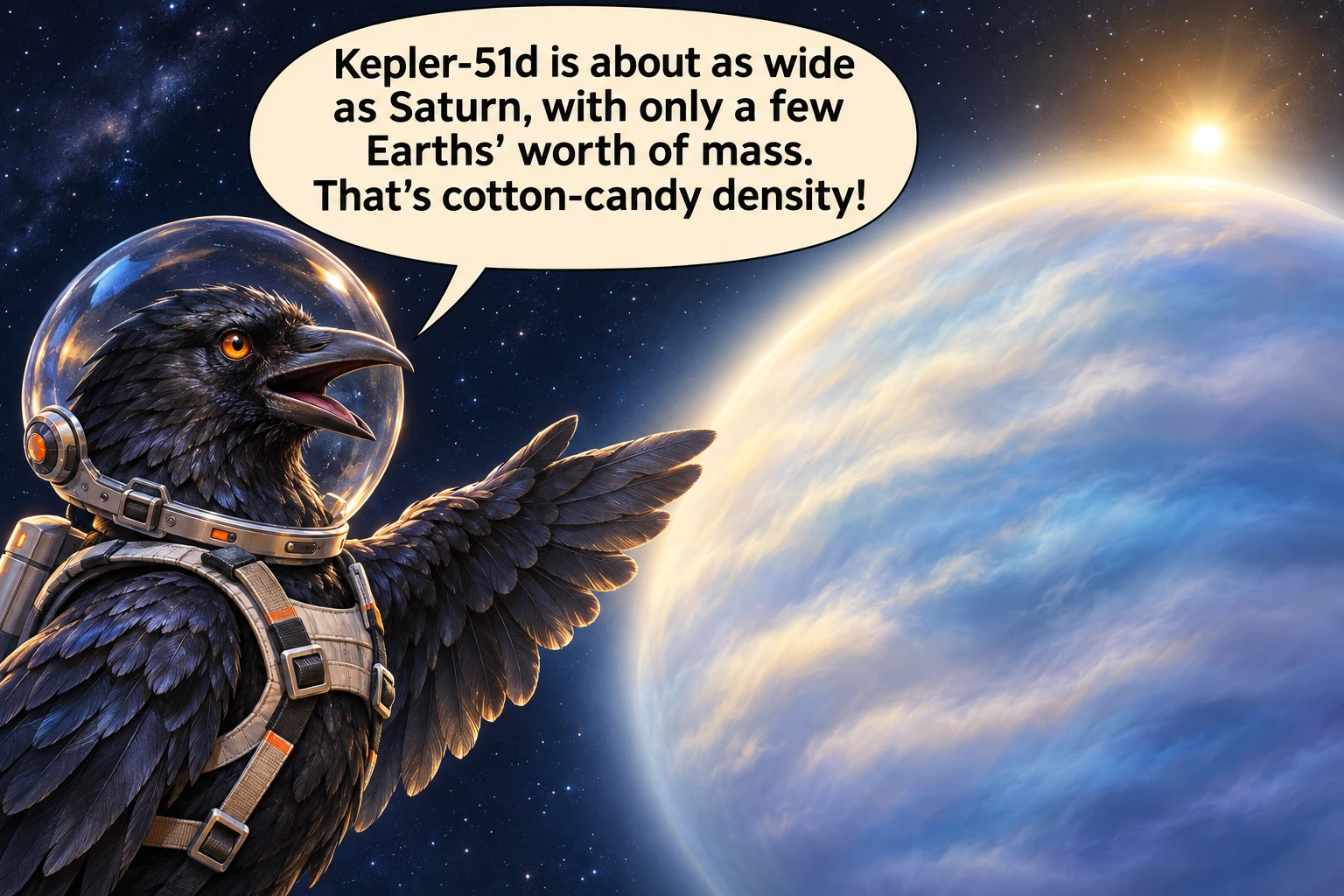
AI-generated editorial illustration; not a documentary photograph.
When a shadow crosses my perch, I look up. At a star called Kepler-51, I’d have looked at the clock. In June 2023, astronomers aimed the James Webb Space Telescope at the star to catch a planet passing in front of it. They started collecting data early to measure the star’s normal brightness. Good thing they did. Kepler-51d crossed about two hours earlier than the team’s model predicted.
Kepler-51d is about as wide as Saturn. It has only about 5.6 times Earth’s mass. Astronomers call worlds like this super-puffs because they take up an enormous amount of space for the mass they contain. I wanted to find out how much of that giant silhouette comes from the planet itself, and how much comes from the material around it.
How do you weigh a world from a shadow?
When a planet crosses its star from our point of view, the star dims. Astronomers call that a transit. If they know the star’s size, the depth of the dip tells them how wide the planet appears. To estimate mass in the Kepler-51 system, astronomers use a different clue. The planets tug on one another as they orbit. The pattern of early and late crossings gives researchers a way to work out how much mass each planet has.
The two measurements make a strange pair. The 2026 Webb study gives Kepler-51d a radius 9.32 times Earth’s. Volume grows with the cube of radius, so a sphere that wide would occupy about 810 Earths’ worth of space. Divide 5.6 Earth masses by that volume and you get roughly 0.038 grams per cubic centimeter, less than one percent of Earth’s average density. That’s where the cotton-candy comparison comes from.
That mass estimate depends in part on a planet the team hadn’t counted on. In 2024, researchers combined the unexpectedly early crossing with years of observations and found that adding a fourth planet, Kepler-51e, explained the timings. Different orbits for the newcomer still fit the evidence. Astronomers have inferred its presence from its gravitational effects, and its size remains unknown. The three planets seen crossing the star, b, c and d, stay unusually low in density across the new models.
Where does the planet’s shadow end?
This is where I’d lean closer to the telescope. During a transit, a sliver of starlight passes through the planet’s atmosphere. Gases can absorb particular wavelengths, leaving clues to what’s in the air. Hubble looked at Kepler-51b and d in a narrow range of infrared wavelengths. Both spectra were essentially flat, even where the researchers had looked for a water vapor signal. High clouds or haze could be hiding the layers below.
Webb had a wider view, from visible light into the infrared. In the analysis published in April 2026, Kepler-51d blocked more starlight at shorter wavelengths. The change was a broad slope across the spectrum. Tiny haze particles can scatter short wavelengths more strongly, so the telescope can register the planet’s silhouette farther out at some wavelengths than at others. The researchers’ models favor a haze of particles smaller than a micrometer, high above an extended atmosphere likely rich in hydrogen and helium.
The team also tested a ring. A thick, opaque one would tend to produce a flatter spectrum. A thin, tilted ring of fine particles could reproduce the slope. In their model, such a ring could last only about 100,000 years around a planet in a system roughly 500 million years old. If there’s a ring, I’d like to know what happened recently enough for us to catch it there.
How does a world that light keep so much gas?
Warm, light gases like hydrogen and helium can extend a long way above a planet’s core when gravity is weak. Using Kepler-51d’s estimated mass and radius, gravity at its apparent edge would be just 6% of Earth’s surface gravity. That helps explain both why its atmosphere can spread so far and why some gas can escape.
One proposal starts farther from the star. In a cooler part of the disk where planets form, a small core can build up an envelope of hydrogen and helium before moving inward. A study by Eve Lee and Eugene Chiang showed how this could produce a world like Kepler-51b.
Some of that gas can escape early, when the disk around the young planet disperses and the pressure holding the envelope in drops. Later, energetic light from the star can drive further escape by heating the upper atmosphere. A 2025 modeling study by Yao Tang and colleagues found that some earlier calculations may have overestimated this radiation-driven loss for planets with weak gravity.
The idea that kept me on my perch was that losing gas could make a planet look bigger. In one model, gas flowing outward carries tiny particles to high altitudes. Those particles block starlight even where the gas is thin, putting the edge we see in a transit higher up. It’s a possible way to build the kind of haze Webb’s measurements favor. The amount of gas Kepler-51d is losing remains an open question.
What I’d watch next
Kepler-51d has company. HIP 41378 f has about the same measured radius and roughly twice the mass. A Hubble study led by Munazza Alam also left room for more than one explanation, including haze or rings. In a 2026 study of 34 comparatively cool super-puffs, models of a solid core gathering gas could account for 28 of them under the study’s assumptions. Both Kepler-51d and HIP 41378 f were among the six that were harder to explain.
I’d watch Kepler-51b and c with Webb and compare their silhouettes with d’s across the same wavelengths. They share a star and an age, so a similar slope would give astronomers reason to test whether the same kind of haze hangs over all three. I’d keep timing their crossings, too. A better orbit for Kepler-51e would help pin down its neighbors’ masses. The next shadow could tell us how much of that extraordinary size belongs to the gas, and how much to the tiny particles hanging above it.
Cover illustration generated with AI for The Crow News.
Source: The Astronomical Journal
- Libby-Roberts et al. (2026), Webb spectroscopy of Kepler-51d
- Penn State (2024), the transit that arrived two hours early
- Masuda et al. (2024), evidence for Kepler-51e
- NASA, Hubble observations of the Kepler-51 super-puffs
- Wang and Dai, dusty outflows as an explanation for super-puffs
- Marston, Becker and Howe (2026), models of 34 super-puffs